Why the Reading Nook Has a Long History
Explore the reading nook’s long history, from shared household seats to personal corners, and learn how its changing role can shape a reading place at home.
The common mistake is to treat a reading nook as a decorating project: add a chair, a lamp and a shelf, then expect the corner to work. The reading nook’s long history offers a more useful lesson: a place for reading depends on the room people have, the books they can reach and the household’s routines.
There is no single origin story for the reading nook. People have read in many kinds of domestic spaces, but the evidence does not support a simple timeline in which one kind of corner gradually became the familiar cosy alcove. A reader might use a shared table, a seat near a window or a room with several purposes. The common thread is the act of making a place available for reading, not a standard design.
Where did people read at home?
The settings varied with a household’s space, resources and daily demands. Some readers had access to a study or library; others used a table or chair in a room shared with family life and work. A dedicated corner was not essential. A text, a place to sit and time to read mattered more than a particular piece of furniture.
Reading also took place in settings beyond the home, including religious communities where books and study had their own routines. Those settings are useful context, but they should not be mistaken for a direct blueprint for the domestic reading nook. Household reading has no single path from a communal room to a private chair.
It helps to think of a nook as a bookmark: it marks a place to return to, but it does not dictate what happens next. A chair, a window ledge or a spot beside a bookcase can all serve that purpose if reading happens there.
How did books and furniture shape a reading place?
Books need somewhere to be kept, and their location can influence where someone chooses to read. In a home with shelves, a cabinet or a small stack of books, a nearby seat may be convenient. In another home, a borrowed book or a digital reader may be enough. Storage can support a reading habit without defining the nook.
A desk or library in a larger home is different from a corner that shares space with other activities. It may support study, writing or correspondence as well as reading. In a multipurpose room, a chair and side table may be the practical option. Neither arrangement tells the whole story of who reads or how much privacy they have.
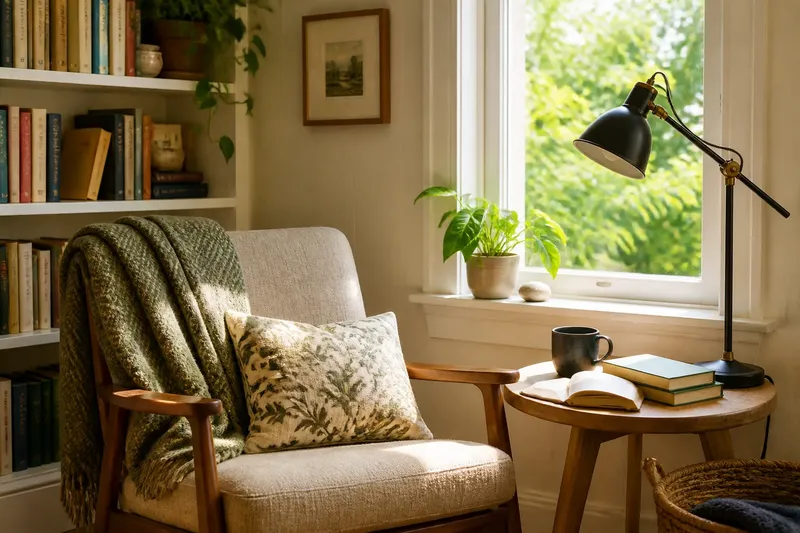
Furniture and lighting can make a spot easier to use. A lamp directed towards the page, a stable surface for a mug or book, and a chair that suits the reader’s needs are practical choices. They do not turn a spot into a nook on their own; repeated use gives it that meaning.
Why might someone want a quieter reading corner?
A reader may want a little separation from household activity without leaving the room or claiming an entire room. That need depends on the person and the household. Some people prefer to read near others; some want fewer interruptions. There is no reason to assume that privacy became a universal domestic expectation at one particular point in history.
A reading place can also shift with the task. Someone might use a chair for a novel, a recipe book or reading aloud to a child. The same spot can make reading easier to begin while remaining part of shared life. It need not be a retreat from everyone else.
Say a family shares one living room, with a bookcase beside the window and a chair often covered with laundry. They move the laundry basket to a cupboard, put a reading lamp and two current books on a nearby table, and leave the chair available. The expected result is observable: the chair is easier to use for reading, though the family still shares the room and may need to move the books when they need the table.
What can a reading corner reveal about household routines?
A quiet place at home can depend on who gets to use it and when. A child may need the table for homework; someone else may need the chair for resting. Reading can be interrupted by chores or conversation, and the room’s layout can make concentration easier or harder. These ordinary negotiations matter more than a romantic image of a nook as an untouched sanctuary.
A shared reading corner can keep a reader close to family activity. A more tucked-away seat may suit someone who wants fewer distractions. Neither choice is more authentic. The useful question is whether the arrangement fits the household’s needs and can be maintained without creating extra work.
How do reading nooks work in homes today?
A modern reading spot might have built-in shelves and an upholstered chair, or it might be a chair already in use for other things. A window seat can hold storage, provide a place to sit and serve as a reading perch. A tablet or e-reader can take the place of printed books for someone who prefers it.
Appearance is a poor guide to whether a nook works. A carefully staged chair may become a landing place for bags if it blocks a busy route. A plain seat that is easy to reach may be used more often. The spot should fit the way its reader actually reads, rather than demanding a separate room or a particular style.
What do readers ask about the history of reading nooks?
When did reading nooks first appear in homes?
There is no clear single starting point for domestic reading corners. People have read wherever their homes offered a suitable place, while furniture, access to books and household routines have varied.
Was a reading nook always a separate room?
No. A study or library is one possible reading space, but a chair by a window or a shared table can serve as a reading place too. The term describes a use of space, not a fixed architectural feature.
Why do reading corners still appeal?
A familiar seat can make it easier to begin reading without requiring a whole room to be set aside. It can also keep books or a reading device close at hand.
Does a reading nook need bookshelves?
No. A basket, a small stack or a digital reader may suit the reader better than shelves. The helpful choice is the one that keeps reading materials accessible without adding clutter or effort.
How can the history help you choose a reading spot?
The reading nook’s history is not a steady progression towards one ideal kind of corner. It reflects the different ways people make room for reading within the spaces and routines they have. That is why a practical seat can matter more than built-in shelves or decorative details.
Notice where you already pause with a book. If the available light is comfortable, the seat is easy to reach and the spot does not obstruct household activity, it may be a better choice than an unused corner. A small table can hold a book; a basket can keep reading materials together; a lamp can help when daylight fades.
For the history of the reading nook, the useful point is that a place becomes recognisable through return, not through appearance alone. Leave the book where you can reach it, and let the spot adapt when the household needs the space for something else.